
How to use hiring signals to find new companies to sell to
A hiring signal is a job posting that tells you a company is about to invest in an area your product helps with. If a startup posts its first sales role, it's about to build a sales process. If a support team is adding five reps, it's short on staff. Search active job postings for the roles tied to the problem you solve, filter out the noise, and message the person the new hire will report to once the posting has been up for a week or two.
When we were targeting Sliq at companies relying on founder-led sales, our best signal was a company hiring its first salesperson: a founding AE, a founding SDR, or a first head of sales. That posting told us the founder was about to hand off sales and was thinking hard about where pipeline comes from. So every day we searched new job postings for those roles, screened the companies, and reached out to the founder. Here's what we learned running it.
Which job postings signal a need for what you sell?
The best roles to search for are the ones a team hires when it starts feeling the problem you solve. Pick the one to three roles closest to your product rather than every role that's loosely related. Here are some common pairings:
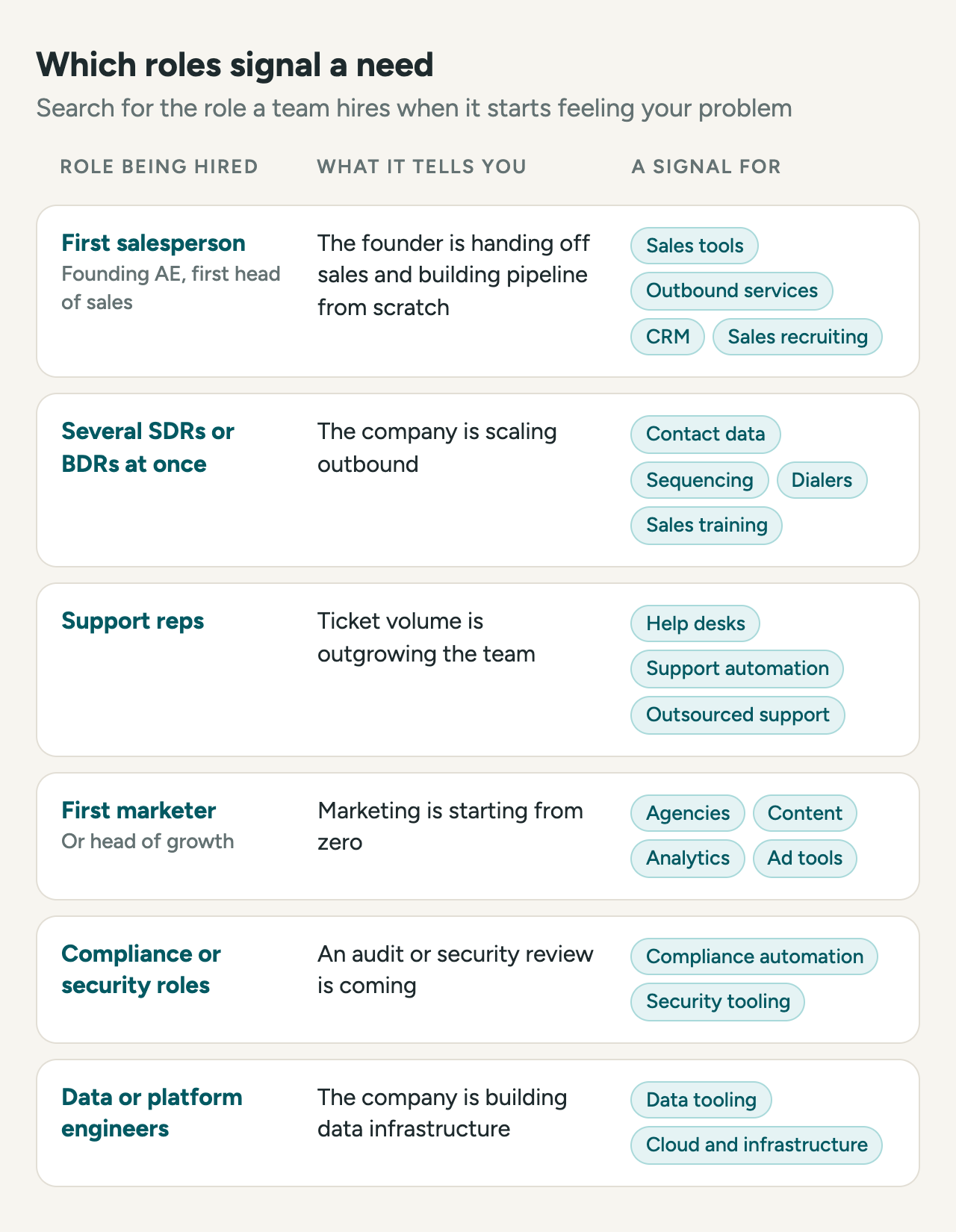
Read the job description too, not just the title. Descriptions often name the tools the team uses or wants to replace. A posting that lists a competitor's product tells you the team already pays for your category, and one that lists a tool you integrate with tells you there's a fit.
How do you find companies from job postings?
Search job postings for your roles, then filter hard: most of what comes back won't fit. These are the steps we follow, along with the mistakes that taught us each one.
- Search by title pattern, not exact title. The same job gets written many ways. A search for "Director of AI Engineering" won't match "Sr. Director, AI & Agentic Platform Engineering", and in one search, exact title phrases like that returned zero results while a pattern that allowed the words in any order found ten. For our signal, the pattern has to catch "founding AE", "founding account executive", "first sales hire", and "head of sales".
- Set a company-size band. The biggest employers post the most jobs, so without a size limit they fill every search. We cap ours at 50 employees, since that's where founders still run sales.
- Don't filter small companies by industry. Job data often has no industry listed for startups. In one of our searches of US companies with 25 or fewer employees, 69% had no industry at all, so an industry filter would have thrown out most of the good results. Filter on size, location, and title, then read what each company does to judge fit.
- Remove recruiters and job boards. Staffing firms post roles for other companies, so they match almost any title search. Be careful with exclude words too: excluding "intern" also drops "internal" and "international" unless you match whole words only.
- Screen out companies you shouldn't sell to. Exclude competitors, companies that sell into your own space, and current customers. A sales-tech startup hiring a founding AE looked like a perfect fit to us on paper, but they compete with us. We learned to exclude those one category at a time, as each kind showed up in our results.
- Keep a record of every company you've checked, including rejects. Job postings stay up for weeks. If you only record the companies you reach out to, the ones you rejected come back in every search and you review them again.
Who should you contact at a company that's hiring?
Contact the person the new hire will report to, not the recruiter. That person felt the need for the role and is deciding how the team will work, which makes them the one who cares about your product. The recruiter's job is filling the role, and the new hire isn't there yet.
- At a small startup, the hiring manager for a first sales or marketing hire is usually the founder or CEO.
- Match the contact to the role's function. At a startup with two cofounders, the right founder for a sales hire is the CEO, not the technical cofounder. We had to tell our search this explicitly, because anyone with "founder" in their title looked like a match.
- At a larger company, contact the head of the team that's hiring. The job description often says who the role reports to ("reports to the VP of Support"). If you can't tell who owns the decision, ask someone near them.
What should you say when reaching out on a hiring signal?
Mention the role they're hiring for in plain words, then ask for their honest take instead of pitching. A founder making their first sales hire is thinking hard about sales, so an opinion on what you've built is an easy thing for them to give. Here's the sequence we used: a connection request with no note, a short message when they accept, and one follow-up five days later if they don't reply.
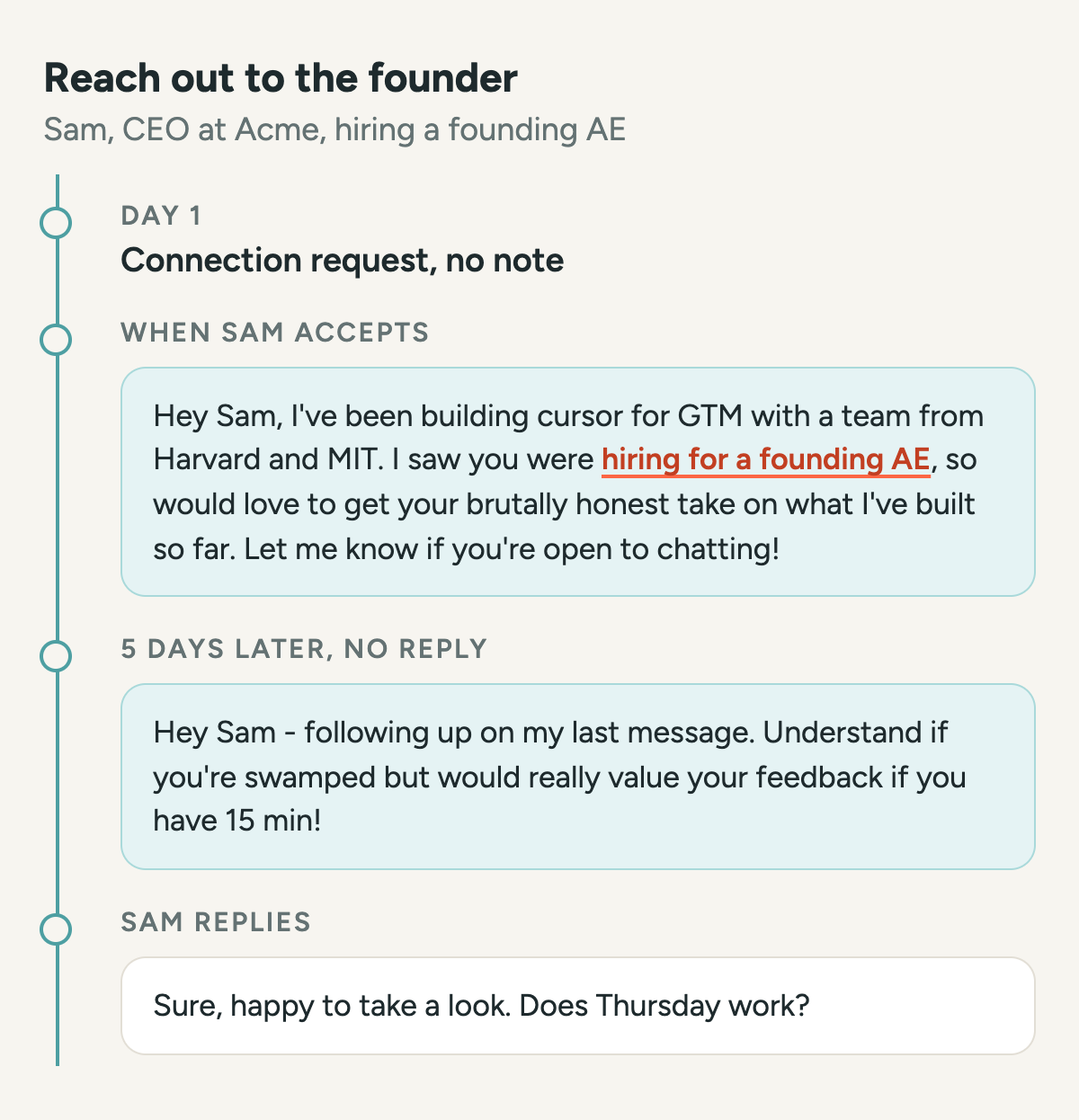
A few things make it work:
- One line of credibility first. Strangers reply to people who seem worth their time. Who's building it, a customer, or an investor all work.
- The role is the reason you picked them. "I saw you were hiring for a founding AE" tells them why they're getting the message, without explaining what the hire means for them.
- Ask for their take, not a meeting. "Your brutally honest take" asks for an opinion, which is easier to say yes to than a demo. Founders who are about to hire for sales usually have strong views on it.
- Keep the follow-up short and easy to ignore politely. Acknowledge they're busy and make the ask small: 15 minutes of feedback.
When should you reach out after a job is posted?
Wait a week or two, then reach out if the posting is still up. The day a role goes live, the hiring manager hears from recruiters, staffing agencies, and every vendor watching the same job boards, and a message that lands in that pile is easy to ignore. A week or two later the noise has died down. If the role is still open, the problem it was meant to solve hasn't gone away, and your message arrives on its own.
A role that's been open for months is an even stronger version of this. It usually means the team is struggling to fill it, so the work the hire was meant to do is still unsolved. If your product can cover part of that work, that's worth saying directly.
Hiring signals vs monitoring target accounts
Monitoring starts from accounts you already chose. Hiring-signal prospecting finds companies you didn't know about. The two work well together.
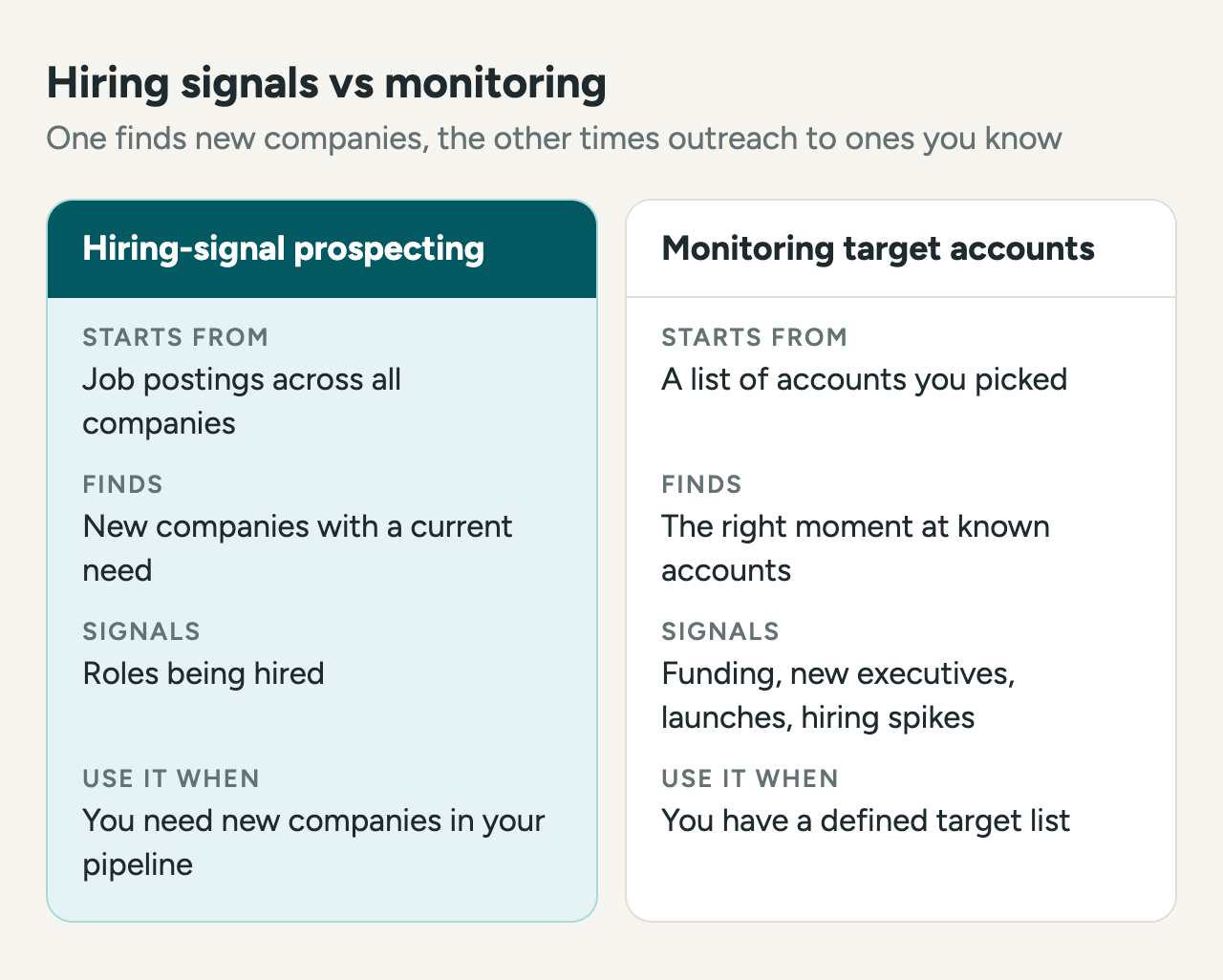
If you already have a target list, see how to monitor target companies for buying signals.
How to automate hiring-signal prospecting with an AI agent
Doing this by hand means searching job boards every day, writing title patterns, filtering out recruiters, checking each company's fit, keeping track of who you've rejected, and finding the right person to message. It's easy to start and hard to keep up.
A Sliq agent does it for you. Tell it which roles signal a need for what you sell, who your ideal customer is, and which competitors and customers to leave out. It searches new job postings every day, screens each company against what you told it, finds the founder or the head of the hiring team, and shows you the new companies and contacts.
Delegate this to a Sliq agent ->
Related workflows
- Monitor target companies for buying signals when you already have a list of accounts to watch
- Ask people near your buyer for a referral when you can't tell who owns the decision
- Personalize your LinkedIn messages to add one more specific detail to your opener
- Choose between email and LinkedIn for each prospect when the hiring manager rarely uses LinkedIn
- What is signal-based outbound?
- Browse all GTM plays
Frequently asked questions
What is a hiring signal in sales?
A hiring signal is a job posting that tells you a company is about to invest in an area your product helps with. A startup hiring its first salesperson is about to build a sales process. A support team adding five reps is short on staff.
How do you use job postings to find prospects?
Pick the one to three roles that point to the problem you solve, then search active job postings for them. Match titles by pattern rather than exact wording, set a company-size band, and remove staffing agencies and job boards. Screen out competitors and current customers, read what each remaining company does to confirm fit, and keep a record of every company you've checked so rejects don't come back the next day.
Who should you contact at a company that's hiring?
Contact the person the new hire will report to, not the recruiter. That's the person who felt the need for the role and is deciding how the team will work. At a startup hiring its first salesperson, that's usually the founder or CEO. At a larger company, it's the head of the team that's hiring, and the job description often names the role it reports to.
What should you say when reaching out about a job posting?
Mention the role they're hiring for in plain words and ask for their honest take instead of pitching. For example: "Hey Sam, I've been building cursor for GTM with a team from Harvard and MIT. I saw you were hiring for a founding AE, so would love to get your brutally honest take on what I've built so far. Let me know if you're open to chatting!" If they don't reply, send one short follow-up about five days later asking for 15 minutes of feedback.
What's the difference between hiring signals and monitoring target accounts?
Monitoring starts from a list of accounts you already chose and watches them for changes like funding, new executives, or hiring spikes. Hiring-signal prospecting starts from the job postings themselves and finds companies you didn't know about. Use monitoring when you have a defined target list, and hiring signals when you need new companies to fill your pipeline.
Last updated: October 2026