
How to reach your target buyer by asking for a referral
If you can't reach the decision maker, or you don't know who it is, ask someone near them. Message a person at the buyer's level in a different function, or one level below the buyer in the right function, and ask one question: who runs this at your company? They get far fewer pitches than the executive, they know the org chart, and a referral ask is a small favor rather than a request for a meeting.
We use this play when the buyer is a senior executive at a large company. VPs and C-suite leaders get pitched constantly, and at a company with tens of thousands of employees it's often unclear whether "AI" or "finance systems" lives with the CIO, the CFO, or someone with a title you've never seen. So alongside the main campaign to the buyers, we run a second one aimed at people who are not the buyer and ask each of them for the right name. Here's what we've learned.
Who should you ask for a referral?
Ask people who know the buyer and get fewer pitches than the buyer does. There are three groups worth targeting.
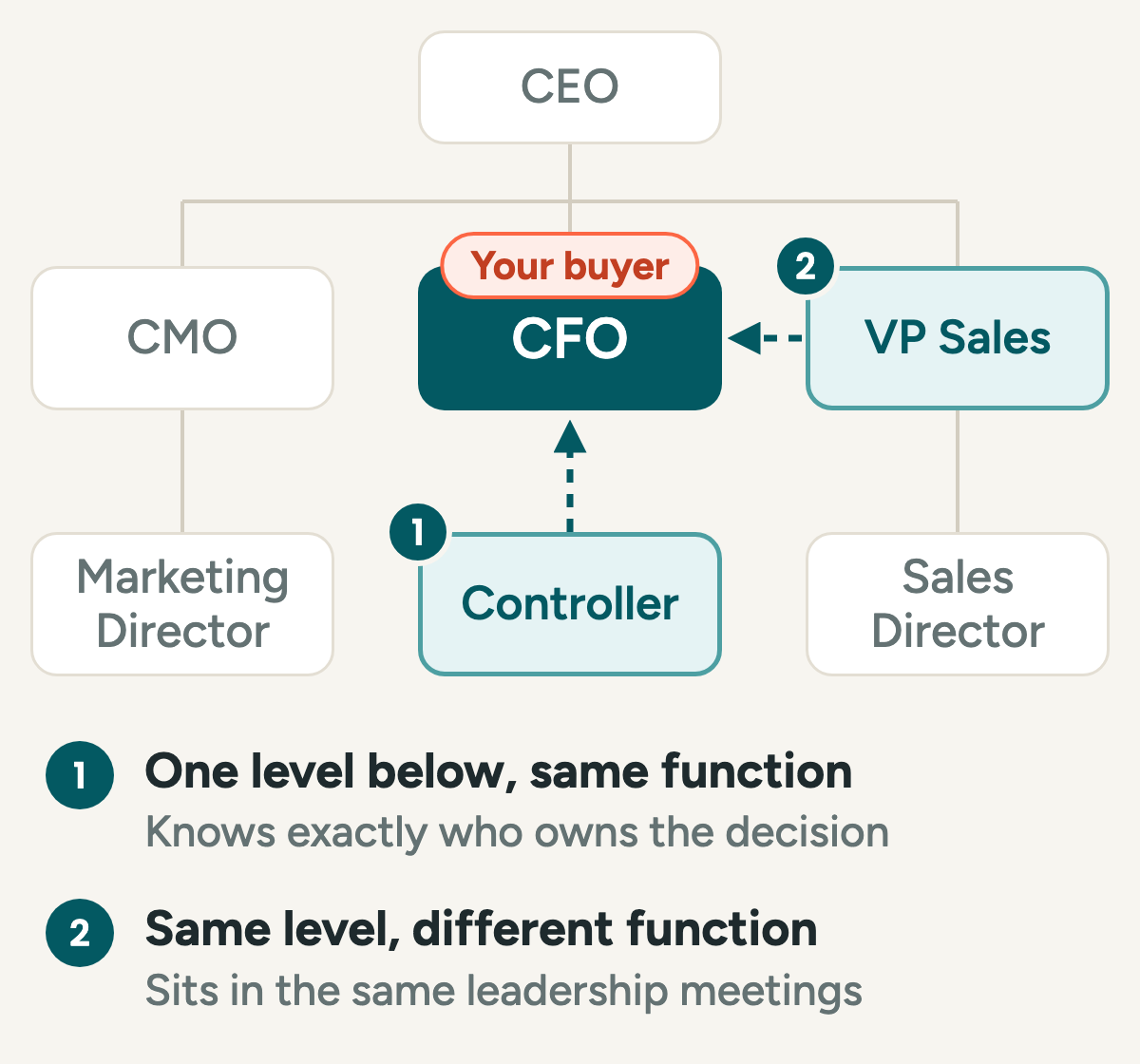
Right level, wrong function
The buyer's peers sit in the same leadership meetings and know each other personally. If you sell to the CFO, the VP of Sales knows exactly who owns finance systems, even though they'd never buy your product. They have no reason to guard the buyer from you, and pointing you to a colleague costs them nothing.
Right function, one level below
The people who report to the buyer know precisely who owns which decision, because they work inside it every day. If you sell to the CIO, a director of IT or a head of enterprise architecture will know whether "AI" lives with the CIO, the CTO, or a new chief data officer.
People one level down are also the most likely to turn into the conversation themselves. Expect some to say "happy to chat first" before naming anyone. That's a meeting with someone who knows the account from the inside, so take it.
People most likely to reply to you
At a large company where you don't know the org chart, you don't need to aim precisely. Start with whoever is most likely to answer you, then let them do the routing:
- People who went to the same school as you
- People in the same city, especially if you can offer to meet in person
- People who worked at a company you also worked at
- People who share a mutual connection with you (here's how to find a warm path into a target company)
- People who recently engaged with a post in your space, since they've shown they care about the topic (see how to build a list from someone else's audience)
Then personalize the message around whatever you have in common.
Why connecting near the buyer helps even without a referral
There's a side benefit to all of this. Once you're connected to several people at a company, the executive you couldn't reach becomes a 2nd-degree connection with mutual connections inside their own company. That alone makes your later connection request to the executive more likely to be accepted.
What should you say when asking for a referral?
Keep the ask to three sentences: one line of credibility, one line on what you're looking for, and one specific question. Here's a suggested sequence you can adapt to your own voice:
A connection request with no note. Let your profile make the first impression.
The referral ask, once they accept:
Hi {first name}, I'm building {one line on what you do} and we're working with {customer A} and {customer B}. We're looking for a few {industry} companies to help shape it. Any chance you could point me to whoever runs {function} at {company}?
One bump after about five business days with no reply, then stop:
Hi {first name}, bumping this in case it got buried. Even just a name would help a lot.
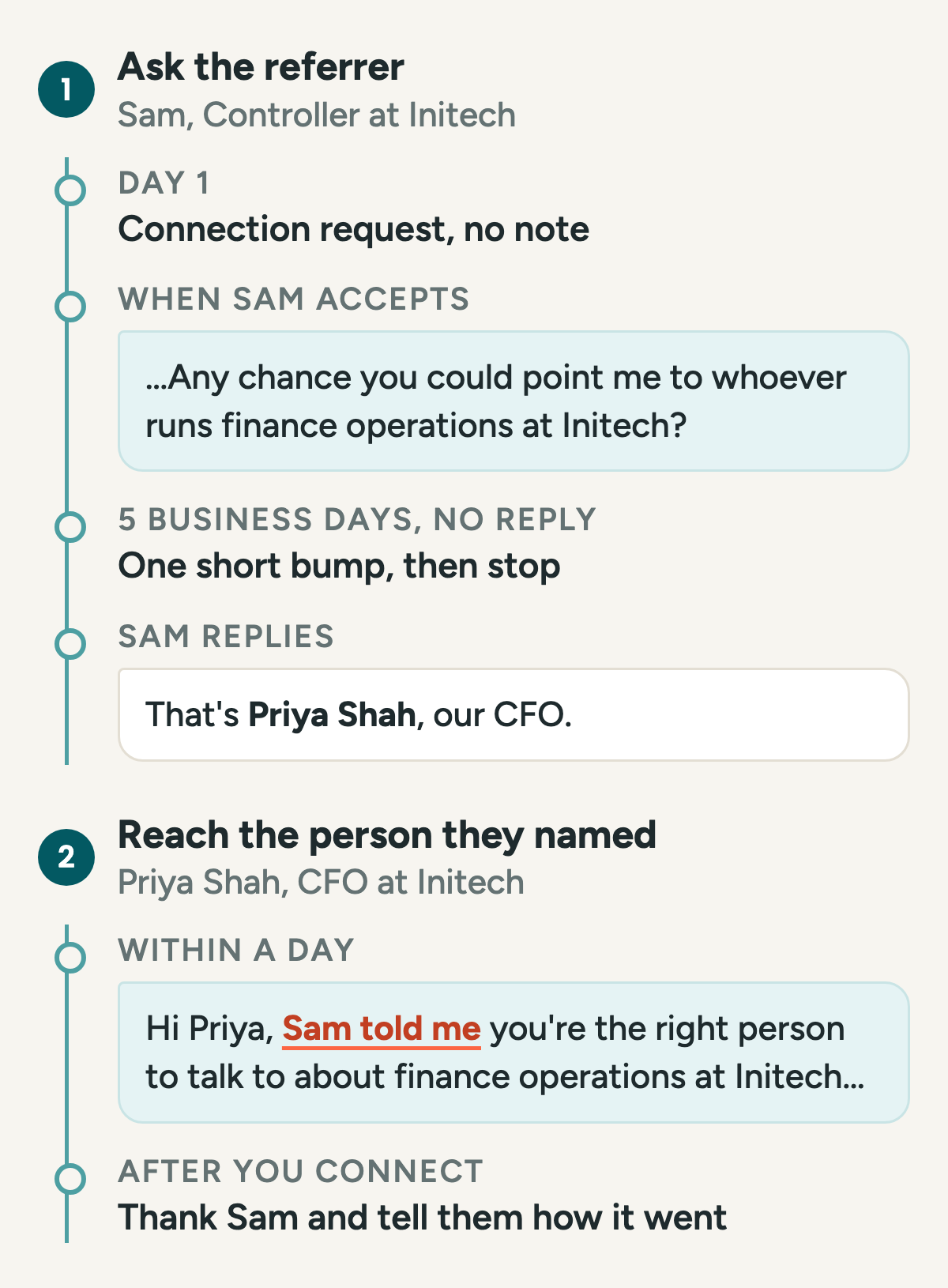
A few things make the ask work:
- Credibility first. Strangers do favors for people who seem legitimate. Named customers, a recognizable investor, or a well-known former employer gives them a reason to bother.
- "Help shape it" instead of "buy it." You're asking them to route a partnership conversation, not to put a vendor in front of their boss.
Have a two-sentence blurb ready
Expect some people to reply with a question before they give you a name: "Which team do you mean?" or "Can you share more about what you're building?" That's a good sign, since they're trying to route you correctly. Answer the same day with a short blurb: the problem you solve, the team that usually owns it, and what you'd want from them (a 20-minute call). A short deck works too, and makes it easy for them to forward you along.
Why does a referral ask get more replies than a cold pitch?
Because the ask is small and the person you're asking isn't being sold to. A cold pitch asks a busy executive for 30 minutes. A referral ask asks someone near them for a name, which takes ten seconds and lets them be helpful. The people you ask also get far fewer pitches than the executive, so your message isn't competing with a crowded inbox.
The replies are often more useful than a name, too. People will tell you how the org is actually structured, which of three similar-sounding teams owns your problem, or that the decision is made centrally in another office. That's account knowledge you couldn't get from LinkedIn titles.
What do you do after someone refers you?
Reach out to the person they named within a day, and always open with the referrer's name. The name is what turns a cold message into a warm one: it tells them a colleague thinks they're the right person, and it's the first thing they'll read. Here's a suggestion:
Hi {referred person}, {referrer} told me you're the right person to talk to about {function} at {company}. {One line on what you do}. Would you be open to a quick call?
Three more habits:
- If they offer to make the introduction, let them. Many people prefer to give the executive some context first rather than share contact details. An intro forwarded by a colleague gets read.
- Close the loop. Thank the referrer and tell them what happened. They now know your product, and they're your contact inside the account.
- Don't treat every reply as routing. Some referrers turn out to be closer to the buyer than their title suggested, and some will want a call themselves. Answer the reply in front of you before you jump to the name.
How to automate referral outreach with an AI agent
Running this by hand means building a list of people who aren't your buyer, tracking who you've asked at each company, answering "which team?" quickly, and following each referral to the next person. That's a lot to keep straight across dozens of accounts.
A Sliq agent runs it as its own campaign: it finds the people near your buyer (peers, people one level down, or people you share a school or city with), screens out your current customers and anyone you're already talking to, sends a connection request with no note, then sends your referral ask and one bump when they accept. You approve each message before it goes out, and when someone names a person, the agent can queue outreach to them that mentions the referrer.
Delegate this to a Sliq agent ->
Related workflows
- Find a warm path into a target company when you'd rather start from people you already know there
- Find who in your network can introduce you when you already know the name of the decision maker
- Build a list from someone else's audience to find people at your target accounts who already care about your topic
- Fix your LinkedIn outreach if your connection requests aren't being accepted in the first place
- Browse all GTM plays
Frequently asked questions
How do you find the right person to contact at a large company?
Ask someone who works there. Instead of guessing the org chart or cold messaging an executive who gets dozens of pitches a week, reach out to someone close to the buyer who is more likely to reply: a peer of the buyer in a different function, someone one level below the buyer in the right function, or someone you share a school, city, or past employer with. Then ask one short question: who runs this at your company?
Who should you ask for a referral to the decision maker?
Ask people who know the buyer and get fewer pitches than the buyer does. The best fits are people at the buyer's level in a different function, who sit in the same leadership meetings, and people one level below the buyer in the right function, who know exactly who owns the decision. At large companies where you don't know the org chart, add anyone you share a school, city, or past employer with.
What should you say when asking someone to refer you?
Keep it to three sentences: one line of credibility, one line on what you're looking for, and one specific question. For example: "Hi Sam, I'm building a tool that automates month-end close and we're working with Acme and Globex. We're looking for a few manufacturing companies to help shape it. Any chance you could point me to whoever runs finance operations at Initech?" A broad area like "whoever runs AI" is fine: if they ask which team you mean, that's still a reply, and a short blurb answers it.
Why does a referral ask get more replies than a cold pitch?
Because the ask is small and the person you're asking isn't being sold to. A cold pitch asks a busy executive for 30 minutes. A referral ask asks someone near them for a name, which takes ten seconds and lets them be helpful. The people you ask also get far fewer pitches than the executive, so your message isn't competing with a crowded inbox.
What do you do after someone refers you?
Reach out to the person they named within a day and always open with the referrer's name, since that's what makes the message warm: "Sam told me you're the right person to talk to about finance operations at Initech." If the referrer offers to make the introduction themselves, let them, because a forwarded intro gets read. Then close the loop with the referrer: thank them and tell them how it went. They're now someone who knows your product inside the account.
Last updated: October 2026